
Jan Bartek – AncientPages.com – A large-scale study of ancient DNA from nearly 16,000 individuals spanning more than 10,000 years in West Eurasia shows that natural selection has influenced modern human genomes much more extensively than previously recognized.
Earlier research on ancient DNA had identified only about 21 clear cases of directional selection. Directional selection occurs when one version of a gene (an allele) that produces an extreme form of a trait—such as the ability to digest lactose after infancy—provides a survival or reproductive advantage.
This advantageous version then becomes more common in the population over generations. The small number of known cases had suggested that such strong selection events were relatively rare over the roughly 300,000 years since modern humans emerged in Africa and began spreading into distinct populations worldwide.
By combining an unprecedented volume of ancient genomic data with new computational techniques, the new study finds that directional selection has actually shaped hundreds of gene variants in West Eurasia since the end of the Ice Age. It also indicates that the pace of selection increased after humans shifted from hunting and gathering to agriculture.
These findings highlight how powerful ancient DNA research can be in revealing human genetic adaptation and clarifying core principles of evolutionary biology.
Many of the gene variants identified are associated with complex physical, psychological, and social traits, including risk for conditions such as type 2 diabetes and schizophrenia. Studying how these traits evolved could improve our understanding of human behavior, health, and disease, and may eventually inform medical treatments. However, some modern trait definitions—such as household income—do not map directly onto prehistoric lifestyles, and the current analysis cannot determine exactly why a given variant was advantageous when it first appeared.
“With these new techniques and a large amount of ancient genomic data, we can now watch how selection shaped biology in real time,” said Ali Akbari, first author of the study and senior staff scientist in the lab of Harvard geneticist David Reich. “Instead of searching for the scars natural selection leaves in present-day genomes using simple models and assumptions, we can let the data speak for itself.”
“This work allows us to assign place and time to forces that shaped us,” said Reich, professor of genetics in the Blavatnik Institute at Harvard Medical School, professor of human evolutionary biology in the Harvard University Faculty of Arts and Sciences, and senior author of the study.
Since 2010, when genome-wide data were first recovered from ancient human remains, ancient DNA research has greatly deepened our understanding of how people from different time periods and regions of the world are related.
However, for many years, geneticists found it difficult to fully use this technology to show how natural selection has shaped human genetic variation over the past 10,000 years, even though enough well-preserved genetic material exists to enable large-scale studies.
A new study has overcome this challenge through two key innovations.
The first innovation involved a long-term effort by the Reich Lab, which spent seven years assembling a large and time-spanning collection of DNA sequences from ancient individuals who lived in West Eurasia—an area that includes present-day Europe and parts of the Middle East. This dataset is sufficiently large and historically comprehensive to support detailed analyses of natural selection over thousands of years.
“If the goal is to uncover changes in the frequency of genetic variants in the last 10 millennia that are greater than can be expected by chance, then we need to detect subtle effects, which requires having thousands of genomes spanning that time period,” explained Reich, who is also a member of the Broad Institute of MIT and Harvard and a Howard Hughes Medical Institute Investigator.
The lab collaborated with more than 250 archaeologists and anthropologists to report new DNA data from 10,016 ancient individuals from West Eurasia. They added those to another 5,820 published ancient sequences and 6,438 modern ones.
“This single paper doubles the size of the ancient human DNA literature,” Reich said. “It reflects a focused effort to fill in holes that limited the power of previous studies to detect selection.”
The second and more important innovation, Reich said, was Akbari’s computational method for isolating directional selection from other causes of gene frequency change, such as migration, population mixing, and random fluctuations in small populations.
“Ali developed a powerful technique that could zoom in on the patterns that actually mattered,” Reich said.
In the end, Akbari detected only a faint signal: by the team’s calculations, directional selection accounted for about 2% of all gene frequency changes.
Around 2% still represents a large portion of DNA. Akbari identified 479 alleles strongly selected for or against in West Eurasian genomes.
He and colleagues determined when and where some alleles spread or disappeared from this gene pool, calculated the overall rate of selection, and detected shifts in that rate.
Selection accelerated after the advent of farming, as different traits became advantageous in agricultural environments.
Over 60% of the strongly selected DNA variants—mostly single nucleotide polymorphisms (SNPs)—are linked to present-day human traits, such as:
- Light skin tone
- Red hair
- Risk of celiac disease and Crohn’s disease
- Immunity to HIV infection and resistance to leprosy
- Lower chance of male-pattern baldness
- Lower risk of rheumatoid arthritis and alcoholism
- Having the B version of the proteins on red blood cells that confer A, B, and O blood types and influence resistance to infection with bacteria and viruses
In some cases, groups of SNPs were under selection together to influence polygenic traits. Some changes raised the frequency of beneficial traits, including some that are interpreted today as:
- “Health span” traits such as faster walking pace
- Measures of behavioral and social status or cognitive functions, such as scores on intelligence tests, household income, and years of schooling
Other changes reduced the frequency of harmful traits, such as those that are interpreted today as:
- Reduced risk of bipolar disorder and schizophrenia
- Lower body fat percentage, waist-to-hip ratio, and body mass index
- Less susceptibility to tobacco smoking
Still other SNPs, such as some that today are associated with susceptibility to tuberculosis and multiple sclerosis, at first rose and then fell in frequency over the millennia, indicating shifts in environmental pressures and the traits that prove beneficial, the team found.
Some of the links seem logical, others counterintuitive, like the major genetic risk factor for gluten intolerance spiking after people began farming wheat.
However, the authors emphasize that there are several crucial factors to understand before interpreting SNP associations like these.
Firstly, what a variant is associated with now is not necessarily why an allele propagated in the West Eurasian gene pool. Reasons for this include:
- Some of the traits that SNPs are associated with in modern societies did not exist in ancient contexts and therefore can’t explain why an allele was originally advantageous or detrimental. A variant that now correlates to household income or years of schooling had to have meant something different in the Stone Age. So these results do not mean that Europeans evolved to be smarter or healthier.
- The fact that an allele shapes a particular trait today also does not automatically mean this trait was important in the past. Perhaps having red hair was beneficial 4,000 years ago, or perhaps it came along for the ride with a more important trait.
- Some SNPs affect multiple traits, so what a genomic database tags a SNP as affecting may not capture everything it’s doing. Today, for instance, we know that the same gene variant that raises risk of sickle cell disease also protects people from malaria, so what looks like natural selection for one disease may be selection against another.
- It’s possible that a flagged SNP is actually in a gene next to the one that natural selection was targeting—another way of coming along for the ride.
- Present-day traits a SNP influences may not yet be known or included in the databases the team analyzed.
Secondly, just because an allele, SNP, or trait swept into or out of West Eurasia during this time doesn’t mean this happened only in West Eurasia.
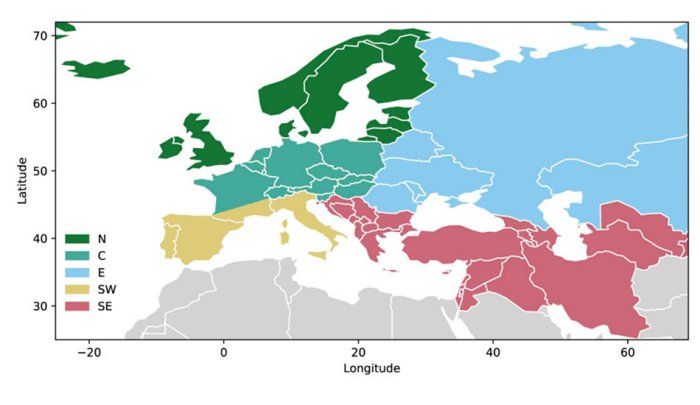
The regions from which ancient and recent human DNA samples were studied in this work. Image: Akbari A et al., “Ancient DNA reveals pervasive directional selection across West Eurasia,” Nature (2026)
Researchers can use the new computational methods to search for directional selection in other populations with sufficient ancient DNA, clarifying what is unique to each group and what generalizes across populations. Reich expects future studies to show that shared selective pressures shaped core traits across diverse groups, even as they split and migrated worldwide over tens of thousands of years.
The team has made its data and methods freely available to spur new research. One direction is to investigate other signals in the data: Akbari and colleagues identified more than 7,600 genetic locations that are likely examples of directional selection and warrant follow-up. For Reich, the most exciting prospects are applying the methods to more groups and further back in time.
“To what extent will we see similar patterns in East Asia or East Africa or Native Americans in Mesoamerica and the central Andes?” he asked. “If we can’t use ancient DNA to study the most important period in human evolution 1 million to 2 million years ago, then at least we can study selective pressure on human genomes during more recent periods of change and learn broader principles.”
It will also be crucial for scientists to conduct molecular studies to better understand the health consequences of selected alleles.
See also: More Archaeology News
It’s possible the results could point scientists to new genetic factors in health and disease that improve experts’ ability to assess disease risk, prevent illness, and develop new medicines. Researchers developing gene therapies might consider whether the gene they’re targeting was flagged in the study as being advantageous, Akbari said.
“You could speculate that if the variant someone wants to knock out was strongly selected for, it’s probably not the best idea,” he said.
Scientists could also use the new methods to study natural selection in other species. Such work could uncover alleles that have made cattle or chickens well suited to domestication, Akbari suggested, or that have helped animals adapt to climate change.
The possibilities are enticing for deepening our appreciation of human diversity, history, and health, Reich said.
“This paper shows how complex selection can be and provides an opportunity to consider the richness of variation in human populations,” he said.
The study was published in the journal Nature
Written by Jan Bartek – AncientPages.com Staff Writer
Get signed up on our Free Newsletter Today!
