
WASHINGTON — In certain circles, America can feel deeply divided. From politics to social media, the loudest voices often highlight what separates us. But a closer look—on the ground and in new data—suggests something more nuanced: Americans may have more in common than it seems.
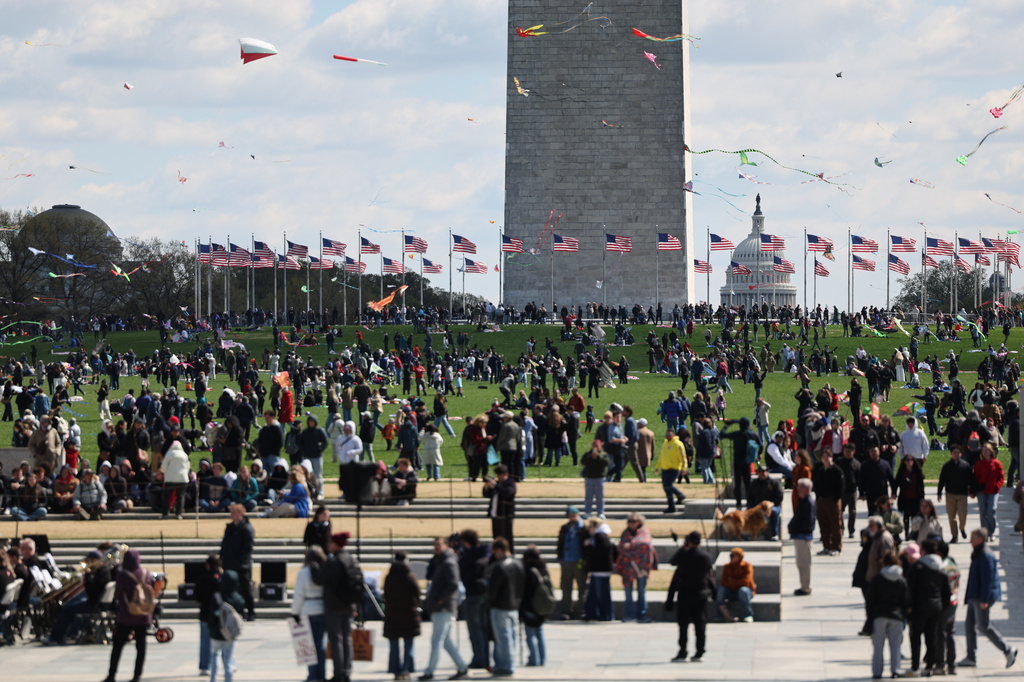
On the National Mall in Washington, D.C., that idea comes into focus.
Against a backdrop of monuments and memorials, people from across the country gather—tourists, students, families, and friends. They come to take in the cherry blossoms, reflect on history, and spend time together. And whether they realize it or not, many are also sharing something deeper.
“This is an annual event for us—to go see the cherry blossoms,” said Arlene, visiting with her friend Rick from western Maryland.
Moments like these—simple, familiar, and shared—stand in contrast to the often divisive tone dominating headlines.

While political tension is real, recent data suggests the story isn’t so straightforward. A Gallup poll finds Americans are among the most anxious in the world about their political system. But a closer look indicates that anxiety may be driven more by perception and rhetoric than by everyday personal interactions.
Many Americans, across political and cultural lines, still align on core values: faith, family, freedom, and hope for the future.
“You know, I do believe we have more in common than we disagree with,” Arlene said. “Everyone, their number one priority is taking care of their families and their children. We all worry about the same things.”
Rick, a member of her bicycling club, sees that unity play out in everyday life.
“We could be riding down any road—you could be a far-left liberal—and people will stop what they’re doing and wave,” he said. “If you have a flat tire, someone will help you. To me, that’s unity, regardless of political beliefs.”
Others visiting the Mall echoed similar sentiments to CBN News.
“If you’re talking politically, there’s division,” said Marco from Annapolis, Maryland. “But in other elements of the country, we’re on the same page.”
Students visiting from Alaska pointed to a lack of dialogue as part of the problem—but also to shared ground beneath it.
“A lot of people are close-minded and don’t want to hear others out,” said Addy. “But I think we have a lot more in common than we think we do.”
The answers aren’t identical, but they reveal a pattern: a quiet consensus that doesn’t always make it online.
Experts say social media and political rhetoric often amplify extremes, making divisions appear wider than they are. But offline—in everyday interactions—that divide can feel much smaller.
“People who are in America love America,” Addy added. “I think that’s what unites us. We disagree on certain things, but we share that love.”

Members of Dance 4 Life, from Claymount, DE., wait to enter the National Cherry Blossom Festival Parade, Saturday, April 11, 2026, in Washington. (AP Photo/Rod Lamkey, Jr.)
For many, unity doesn’t mean total agreement. It means maintaining relationships despite differences.
“I do have disagreements with some of my friends politically,” said Dylan, a student from California. “But I can’t let that get in the way of our friendship. Blood is thicker than water—nothing can break apart family.”
Pastor Mark Batterson of National Community Church in Washington says division is not unique to this moment in history. “I would say we’re no more divided than the day and age Jesus lived in,” he said.
He believes unity begins with recognizing the God-given dignity in others—and choosing a different tone.
“This is a moment… to stand in the gap as peacemakers, grace givers, truth tellers, and tone setters,” Batterson said. “We’re called to shift the atmosphere with faith, love, and hope.”
Back on the National Mall, the monuments stand as reminders of a nation that has faced division before—and endured. It’s long been a place where Americans come to express differences, but also where they’re reminded of what they share.
And for those visiting, the message is clear: unity may not always be loud, but it is still present.
Even Arlene and Rick—who hold different political views—can laugh about it.
“I have liberal beliefs,” Arlene said.
“And I’m a conservative evangelical Christian,” Rick replied.
“You are? I didn’t know that!” she laughed. “I don’t know if I can ride with you anymore!”
It’s a small moment, but a telling one.
Because while the loudest voices may dominate the national conversation, a quieter majority may be telling a different story—one not of deep division, but of a country still searching for, and holding on to, unity.
Get signed up on our Free Newsletter Today!
