
Conny Waters – AncientPages.com – For thousands of years, humans have used various waterproofing materials on ships and boats to protect them from seawater and marine organisms. However, research has traditionally focused on wooden components, and non-wood materials—especially waterproofing coatings—have received relatively little attention.
A new study published in Frontiers in Materials begins to fill this gap. Researchers from France and Croatia analyzed the protective coatings of the Roman Republic shipwreck Ilovik–Paržine 1, which sank about 2,200 years ago off the coast of present-day Croatia. By examining pollen grains trapped in the coatings, they were able to reconstruct the vegetation of the landscapes where the ship was originally built and later repaired.
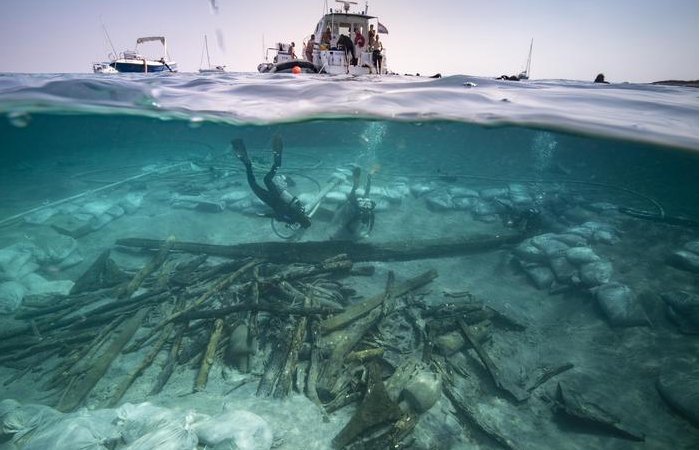
View of the excavation of the bow area of the Ilovik-Paržine 1 shipwreck. In the foreground, the cargo of logs and amphoras can be seen. Archaeologists are working near the structure of the bow complex. Credit: Adriboats © L. Damelet, CNRS/CCJ
Their analysis revealed several distinct layers of coating, suggesting that the ship was treated multiple times, likely at different ports or shipyards around the Adriatic Sea. This layered evidence provides insight into the vessel’s different “life stages” and highlights the diversity of shipbuilding and maintenance traditions in the ancient Mediterranean.
Examination Of Organic Waterproofing Materials
“In archaeology, little attention is paid to organic waterproofing materials. Yet they are essential for navigation at sea or on rivers and are true witnesses of past naval technologies,” said first author Dr. Armelle Charrié, an archaeometrist at the Laboratory of Mass Spectrometry of Interactions and Systems in Strasbourg.
“Studying the coatings, we found two different kinds on this vessel: one made of pine tar, also called pitch, and the other of a mixture of pine tar and beeswax. Analysis of pollen in the coating made it possible to identify the plant taxa present in the immediate environment during the construction or repairs of the ship.”
Resin And Wax
The wreck was discovered in 2016, and both the ship and its cargo have since undergone several examinations. The current study is the first to integrate pollen analysis with molecular techniques to identify the ship’s protective coating and the types of vegetation present when it was produced and applied to the hull. This research is a collaborative effort between the Department for Underwater Archaeology of the Croatian Conservation Institute and the “ADRIBOATS” program at the Centre Camille Jullian, Aix-Marseille University in France.
“Some regions throughout the Adriatic have particular characteristics that led local populations to develop a specific shipbuilding style,” said Charrié. “Only studies like ours offer an overview into these traditions which bear witness to genuine know-how and diverse traditions.”
Researchers examined the coatings using structural, molecular, and pollen analyses, including techniques such as mass spectrometry, which can identify and quantify unknown components in organic mixtures.
Analysis of 10 coating samples revealed the biological origin of the natural substances used on the ship. The resulting “molecular fingerprint” showed molecules typical of pine trees, indicating that the primary ingredient in all the coatings was heated coniferous resin or coniferous tar, commonly known as pitch.
However, one sample differed in composition. It contained a mixture of beeswax and tar, a blend known to Greek shipbuilders as zopissa. This combination improves the adhesive’s flexibility and makes it easier to apply when heated.
Trapped In Pitch
Pitch is naturally sticky and can trap and preserve pollen from surrounding landscapes. By analyzing these pollen grains and their relative abundances, researchers were able to narrow down the regions where the pitch was likely produced and where it may have been reapplied during later repairs.
Pollen from coating samples taken from Ilovik–Paržine 1 revealed a wide variety of environments. The identified landscapes included typical Mediterranean and Adriatic coastal and valley settings, with forests of holly oak and pine, as well as matorral—a type of Mediterranean shrubland—where olive and hazel trees grow. The presence of alder and ash indicates vegetation growing near rivers and seashores, found either along the coast or in nearby inland areas. Small amounts of fir and beech pollen were also detected, indicating vegetation typical of mountainous regions along the north-eastern Adriatic coast, where the Istrian and Dalmatian mountain ranges are relatively close.
See also: More Archaeology News
The analysis further showed that the ship likely received four to five separate coating applications. The stern and central sections shared the same coating, while three distinct batches were identified at the bow. This pattern suggests that the ship was repaired multiple times, using materials obtained from different locations around the Mediterranean.¨
“While it seems obvious that ships sailing long distances need repairs, it’s simply not easy to demonstrate this,” concluded Charrié. “Pollen has been very useful in identifying different coatings where the molecular profiles were identical.”
Source: Frontiers
Written by Conny Waters – AncientPages.com Staff Writer
Get signed up on our Free Newsletter Today!
