
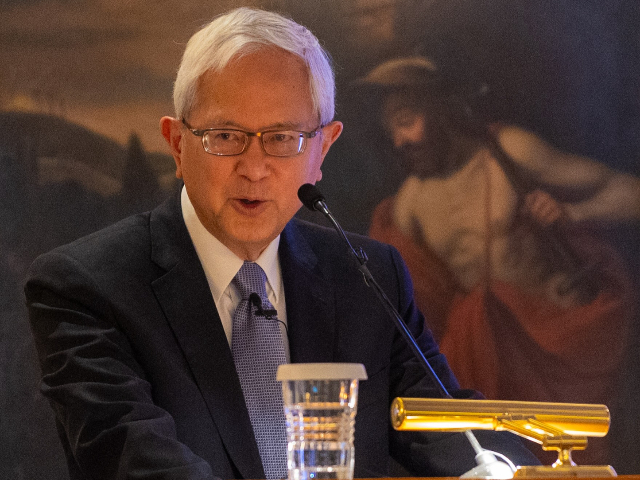
Artificial intelligence may be one of the most powerful tools of the modern age, but power alone will not make it good, Elder Gerrit W. Gong said on Tuesday, May 26, 2026. (Full video and text remarks.)
Speaking in the shadow of Acropolis, the birthplace of democracy, at the Athens Summit on AI Ethics, the Apostle of The Church of Jesus Christ of Latter-day Saints urged faith leaders, scholars and technology experts to help anchor AI with a moral compass. The summit was organized by the American Security Foundation.
“Morally grounded AI, as a tool, can open human opportunity to do and become good. We will not fulfill AI’s full potential until we make it as morally good as we make it powerful,” Elder Gong said. “And we will not reach our full human potential until we, and not any technology, take responsibility to chart our best future.”
Elder Gong spoke of the potential for AI to offer a “gift of possibility”—where “anyone anywhere can become their best self, make their greatest contributions, and fulfill their God-given potential.”
“We want AI to expand human agency and capacity to do good; prioritize learning and admirable human character; and empower individuals with dignity and place as we contribute with purpose and meaning in a world of transformed work,” Elder Gong said.

Gong-AI-Athens
Elder Gerrit W. Gong, an Apostle of The Church of Jesus Christ of Latter-day Saints, speaks during the Athens Summit on AI Ethics in Athens, Greece, on Tuesday, May 26, 2026.2026 by Intellectual Reserve, Inc. All rights reserved.
But he warned that increasingly powerful AI systems have not focused on acknowledging human experiences, virtues, and values needed to make a robust “gift of possibility” a reality. He warned that a “winner takes all” AI race risks AI being untethered from human dignity and morality.
Emphasizing the responsibility of faith communities in guiding technological development, Elder Gong said, “To offer all it can for the greater good of individuals and societies, artificial intelligence needs to reflect faith, moral compass, and the gift of possibility.”
Elder Gong explained that moral grounding in AI would not privilege one religion or make technology overtly religious. Rather it means drawing on the wisdom of the world’s faith and ethical traditions, pointing out that 75% of the world’s population today maintain a religious identity.
|
Temple Square is always beautiful in the springtime. Gardeners work to prepare the ground for General Conference. © 2012 Intellectual Reserve, Inc. All rights reserved. |
1 / 2 |
Download Photos
“We know lived faith and learned wisdom can help AI personas be both effective and good,” he said. “The world’s great religious, philosophical and ethical traditions have guided human civilization for millennia,” he said. “We need that wisdom and those values to anchor AI today.”
“We have profit-motivated companies and politically motivated politicians,” said Rev. Johnnie Moore, Vice Chancellor and Managing Director of Middle East Studies at Pepperdine University. Moore said a small group of people are making decisions for the rest of us, and all of our religious traditions warn about the possibility if people behave like gods.
“Wisdom teaches us about limits, and of course, the alarm that we get from AI is there is no limit,” said Angelican Bishop Martin Warner, who is a member of the House of Lords.

Gong-AI-Athens
Elder Gerrit W. Gong, an Apostle of The Church of Jesus Christ of Latter-day Saints, and his wife, Susan, talk with Bishop Martin Warner during the Athens Summit on AI Ethics on Tuesday, May 26, 2026.2026 by Intellectual Reserve, Inc. All rights reserved.
In his address, Elder Gong said AI personas and models could be grounded by protecting and promoting human moral agency, imbuing them with a moral compass, disclosing AI transparency, preserving human ability to pause, and mitigating AI tendencies to a will to power, bias, deceit, narcissism, sycophancy, and self-preservation.
During the summit, researchers from leading faith-based universities representing diverse religious traditions — Baylor University, Brigham Young University, the University of Notre Dame and Yeshiva University — announced the formation of the Consortium for Evaluating Faith and Ethics in AI (CEFE-AI). The consortium seeks pluralistically to benchmark and reduce bias in the way AI systems represent faith communities and their beliefs.

Gong-AI-Athens
Elder Gerrit W. Gong, an Apostle of The Church of Jesus Christ of Latter-day Saints, speaks during the Athens Summit on AI Ethics in Athens, Greece, on Tuesday, May 26, 2026.2026 by Intellectual Reserve, Inc. All rights reserved.
“By bringing in people with different perspectives, it only makes the project that much richer intellectually, and yields an outcome, that’s going to be much more impactful in society,” said Dr. Jeffrey Rhoads of University of Notre Dame which is part of the consortium.
“I’m hoping that we’ll see an AI community that is contributing to humanity in the most positive way,” said Rabbi Daniel Feldman of Yeshiva University. “To do that they need to be informed fully by the religious concerns of so much of humanity and the recognition that all intelligence, artificial or otherwise, is uplifted and defined by the recognition of the Creator.”
“I’m glad as a faith leader that we are addressing concerns about possible harms and actual harms that are happening right now with AI,” said Rev. Dr. Marian Edmonds-Allen, Senior Advisor, American Security Foundation.
Get signed up on our Free Newsletter Today!
