

Jan Bartek – AncientPages.com – A new genetic study offers comprehensive insight into the rich cultural diversity of the so-called Southern Cone – the roughly triangular southernmost part of South America – by showing how strongly it was shaped by extensive human migration.
An international research team, led by the Senckenberg Centre for Human Evolution and Palaeoenvironment at the University of Tübingen and supported by several South American institutions, carefully analyzed the genetic material of 52 Indigenous individuals who lived in the Pampas, northwestern Patagonia, the Paraná Delta, and the eastern lowlands of Uruguay over the past 6,000 years.
Their work reveals, among other important insights, that at least three genetically distinct population groups coexisted in the Pampas during the mid-Holocene. This finding highlights and honors the complexity and depth of Indigenous histories in the region, illustrating that large-scale migrations have been a key driver of the remarkable genetic and cultural diversity of southern South America.
At the same time, the study gently underscores how European colonization profoundly reshaped present-day South American societies. The once-vibrant diversity of Indigenous languages, religions, worldviews, and political structures was largely supplanted by European systems, reminding us of the immense cultural richness that existed and the importance of recognizing, valuing, and preserving Indigenous heritage today.
“This was accompanied by a massive displacement of the Indigenous population, whose genetic diversity is still greatly reduced today,” explains Prof. Dr. Cosimo Posth from the Senckenberg Centre for Human Evolution and Palaeoenvironment at the University of Tübingen (SHEP), and he continues, “In recent years, studies of ancient genomes of Native Americans have significantly enhanced our understanding of how South America was once populated. However, one region that has been poorly studied in terms of genetics to date is the Southern Cone, the southernmost part of the continent that was colonized by humans.”
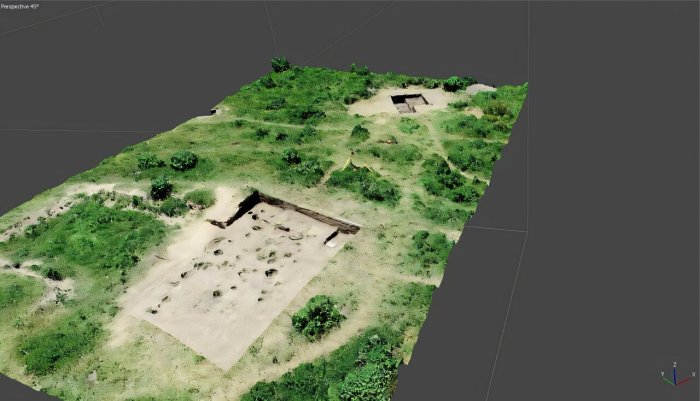
Drone image and 3D model of the Los Tres Cerros 1 site in the Paraná river delta. Credit: University of Tübingen
Together with the study’s first author, SHEP doctoral student Kim-Louise Krettek, and an international research team, Posth has helped fill important temporal and spatial gaps in our understanding of how the Southern Cone was populated, using genetic evidence.
To achieve this, researchers from Tübingen analyzed genetic data from 52 Indigenous individuals recovered from 31 archaeological sites across four regions of the Southern Cone. “The fossil remains we examined come from the mid- and late Holocene of the central and southern Pampas, northwest Patagonia, the Paraná and Uruguay deltas, and the eastern lowlands of Uruguay; they are between 6,000 and 150 years old,” Krettek explains.
Previous archaeological discoveries had already suggested that cultural practices in this region changed significantly during the mid- and late Holocene.
“However, it is still debated today whether these changes were just caused by cultural processes or they also involved human migrations,” adds Posth.
Recent genetic analyses reveal that during the mid-Holocene (about 8,200–4,200 years ago), at least three distinct genetic lineages were present in the Pampas region. While there was some contact with groups from southern Patagonia, this interaction appears to have been relatively rare.
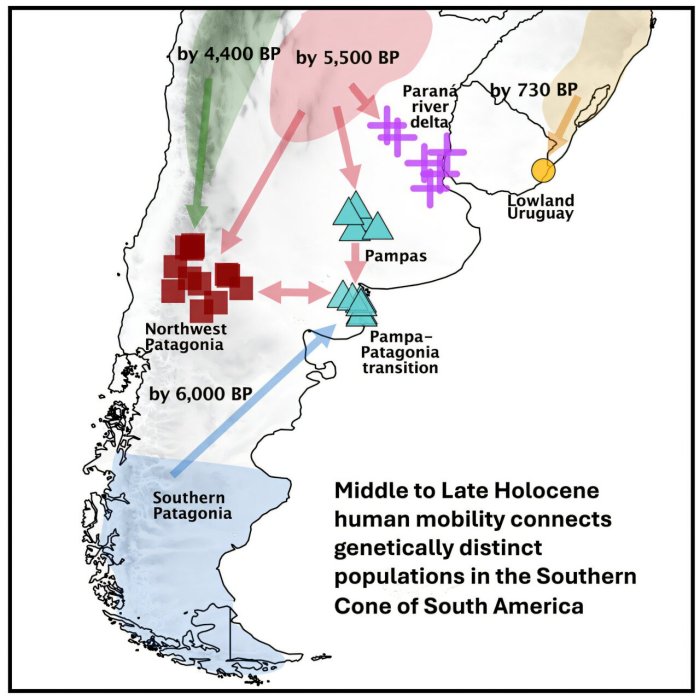
Credit: Current Biology (2026). DOI: 10.1016/j.cub.2026.03.081
More notably, researchers identified a genetic lineage of still-unknown geographic origin that had already spread through the region by around 5,500 years ago. During the late Holocene, the proportion of this lineage increased substantially. This same lineage had also reached northwest Patagonia by at least 600 years ago, where it coexisted with populations carrying a genetic profile associated with the southern Andes up until the colonial era.
By around 1,500 years ago, genetic differences had already emerged between populations living along the Paraná River delta and those in the lower reaches of the Uruguay River. Additionally, individuals from the eastern lowlands of Uruguay show genetic affinities with Sambaqui groups from the southern coast of Brazil, indicating broader regional connections.
See also: More Archaeology News
“Our study reveals that large-scale migratory movements in southern South America during the mid- and late Holocene had a lasting impact on the genetic and cultural landscape of the Southern Cone,” emphasizes Krettek.
“In summary, we can state that genetically distinct groups spread across all the regions studied. Our finding that cultural changes were influenced by migration and intermixing for thousands of years confirms the deep roots of the Indigenous heritage,” adds Posth in conclusion.
The study was published in the journal Current Biology
Written by Jan Bartek – AncientPages.com Staff Writer
Get signed up on our Free Newsletter Today!
