
Conny Waters – AncientPages.com – A new study from the HistoGenes project, co-led by Patrick Geary, Professor Emeritus in the School of Historical Studies, is providing scholars with a clearer understanding of Early Medieval populations in Western Europe and the societies they formed after the fall of the Roman Empire.
This study questions the idea that Barbarian groups easily took control during the Early Middle Ages.
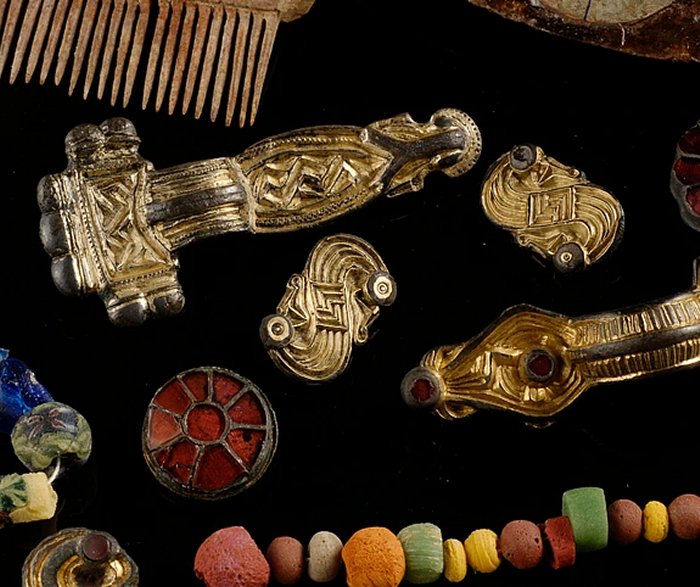
Collection of artefacts from the sixth-century cemetery at Szeleste, Hungary. Image credit: Savaria Museum, Szombathely, Hungary
The team, led by Yijie Tian (Stony Brook University) and István Koncz (Eötvös Loránd University, Hungary), published their findings in Science. By combining ancient human DNA analysis with archaeological evidence, they sequenced the genomes of over 300 individuals from the Little Hungarian Plain in northwestern Hungary.
The team discovered that during the Roman period, communities in the region were part of a strong network built on infrastructure and cooperation. Most people had southern European roots, but there was also clear genetic diversity from Asia and Africa, highlighting the Roman Empire’s diverse population.
However, the post-Roman sites showed an increase in northern European genetic ancestry, reflecting large-scale population movements into the region. By integrating their genomic data with archaeological material, the researchers surmised that the influx of individuals with northern European ancestry likely reflected the historically documented—yet debated—expansion of the Lombard Kingdom from north of the Danube River into former Roman territories during the early sixth century.
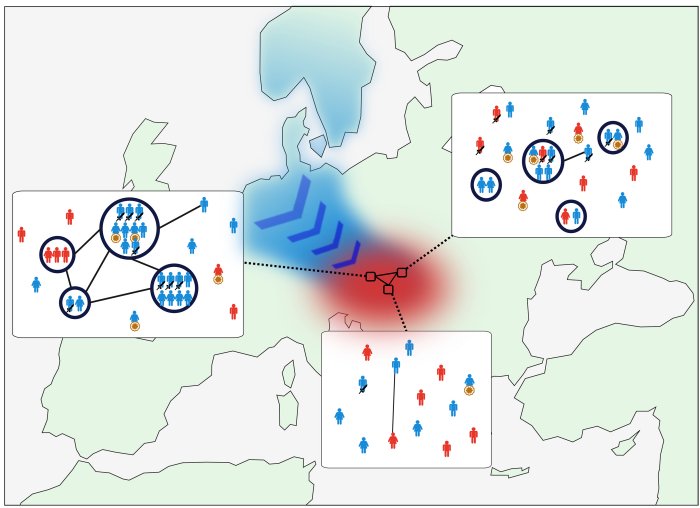
From migration to a hierarchically structured post-Roman polity. This schematic illustrates the formation of differing forms of sixth-century communities through the convergence of migrating Northern European (blue) and local Southern European (red) ancestry. By combining ancient DNA, isotopic data, and archaeological data, we are able to reconstruct the emergence of complex regional hierarchies in the post-Roman world. Image source
They also found that these new communities did more than form scattered rural settlements. Additionally, they built a diverse and structured society, with ruling elites who shaped a new political order after the Roman era. The findings of this study matter because historians still have limited knowledge about life in this region after the Roman period.
This period is often linked to the migration of groups known as “Barbarians,” who came from different parts of Europe and Asia and took control of much of Europe as the Roman Empire fell apart.
It was a historical period of great importance in Europe.
When the Western Roman Empire collapsed in the 5th century, Europe broke up into many new states led by groups the Romans called “barbarians.” For the Romans, this word just meant “foreigner” or someone outside Greco-Roman culture. Most of these groups were Germanic or Celtic peoples who set up their own kingdoms and laid the groundwork for today’s European countries.
These Barbarian kingdoms left behind very few written records, so historians and archaeologists mostly depend on the perspectives of the Romans they conquered.
The HistoGenes team’s findings offer a different view. In the Little Hungarian Plain, even though the migrating Lombards became the ruling power, new communities formed through interactions between groups of mostly northern European ancestry and local people of mainly southern European ancestry.
Together, they helped create a complex new society.
Patrick Geary spoke about the importance of the HistoGenes project and its discoveries.
See also: More Archaeology News
“The project has revealed both gradual and localized forms of movement across short and long distances, as well as rapid, large-scale population shifts from Eastern Asia into the Carpathian Basin,” he said, It has also demonstrated that material culture and genetic ancestry do not necessarily coincide and has illuminated the diverse ways newcomers integrated into existing populations.”
The project’s team included geneticists, archaeologists, historians, and anthropologists who have studied over 6,000 people who lived in Central Europe from 400 to 900 C.E. The funding to this research came from the European Research Council (ERC).
Written by Conny Waters – AncientPages.com Staff Writer
Get signed up on our Free Newsletter Today!
