
Jan Bartek – AncientPages.com – Who wants war? The majority of people want to live in peace.
“War is hell,” as the saying goes, and it is often those who know conflict most closely who long the deepest to leave it behind.
That longing for peace is quietly echoed at a newly uncovered archaeological site from the Western Zhou dynasty (1046–771 BC) in Shaanxi province, northwest China, which was revealed in 2022 and announced by researchers in mid-March 2026.
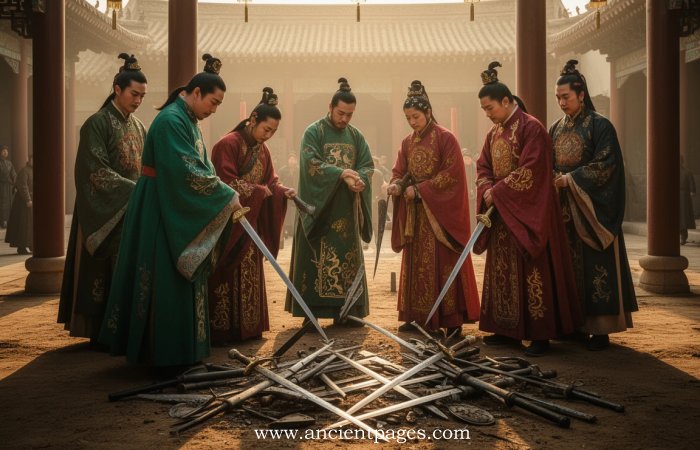
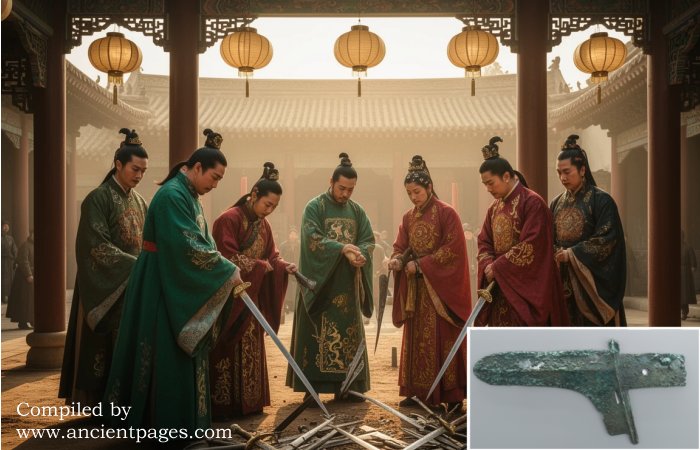
Among the discoveries was a gravesite where individuals were buried with deliberately broken weapons. This practice reflects an ancient Chinese philosophy summed up in the phrase “stopping war is true valor” (zhigeweiwu in Chinese).
The phrase comes from the Zuozhuan (circa 300 BC), a foundational classic of Chinese historiography. Its message is subtle but powerful: while victory in war may be wrapped in glory, the deepest honor belongs to those who seek to end violence and pursue peace.
Yu Pengfei, an archaeologist from the Shaanxi Academy of Archaeology involved in the excavation, explained to the Global Times that the bronze daggers and knives were intentionally damaged during burial. They were meant as offerings, guiding the deceased toward a more peaceful passage into the afterlife.
The site itself, encircled by a moat, contained multiple ash pits and tombs, with 13 graves unearthed so far. Strikingly, the graves do not follow a clear or rigid layout. Among the artifacts recovered were tripod jars, basins, and various pots—quiet remnants of everyday life that, together with the broken weapons, suggest a society reflecting deeply on the cost of war and the value of peace.
Chaos And A New Era
The discovery took place on the outskirts of Xian, the capital of the Western Zhou dynasty, and the archaeological find has opened a powerful window into a turning point in Chinese history. The Western Zhou period was not just another era; it was a transformative age that gave rise to the “mandate of heaven,” a profound idea that leaders used to justify the overthrow of the Shang dynasty (1600–1050 BC) and to redefine what it meant to rule with legitimacy.
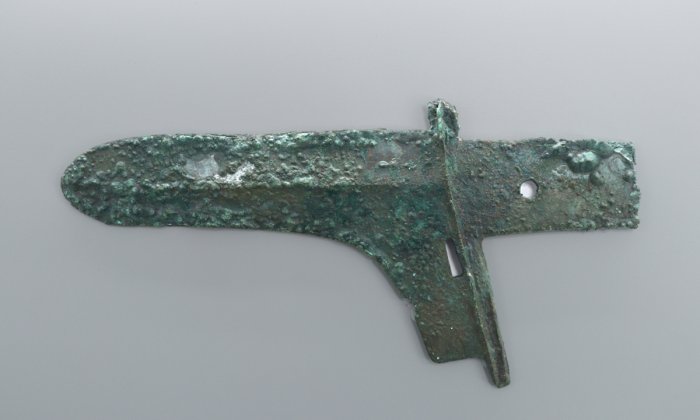
Photo: Courtesy of Shaanxi Academy of Archaeology
After the death of its first leader, King Wu, in 1043 BC, the early Western Zhou empire was thrown into turmoil. Civil war erupted as King Wu’s brothers struggled for power. Yet out of this chaos came a new order. Once the conflict subsided and power was consolidated, China emerged as a land of colonies and regional states, a reality recorded in the Zuozhuan and confirmed by archaeological discoveries. From disorder, a new political landscape was born.
This era is especially inspiring because it marks the first time in Chinese history that written records and archaeological evidence can speak to each other. The zhigeweiwu site stands as a shining example: here, artifacts unearthed from the earth are brought to life through the words of the Zuozhuan, allowing us to bridge the gap between past and present with unprecedented clarity.
The Zuozhuan itself is more than a chronicle. It is a vivid narrative of the political, military, and social currents of the Spring and Autumn period (770–476 BC), while also reflecting back on the Western Zhou to provide essential context. It preserves not only events, but the wisdom, tensions, and aspirations of an age in flux.
As a treasury of Chinese sayings and idioms, the Zuozhuan helped shape enduring ideas, including the philosophy that “stopping war is true valour.” Time and again, it offers moral reflections directed at the ruling elite, reminding them—and us—that true strength lies not in conquest, but in restraint, justice, and humanity.
See also: More Archaeology News
Beyond its literary brilliance, the Zuozhuan is one of the rare surviving works from the time of Confucius and his contemporaries. Its survival across millennia is itself a testament to its power. Through its pages, we gain not only historical knowledge but a deeper understanding of the world that shaped one of history’s most influential thinkers.
In studying it, we are reminded that ideas born thousands of years ago can still illuminate our path today, guiding us toward wiser leadership, deeper reflection, and a more humane vision of power and responsibility.
Source: South China Morning Post, Global Times
Written by Jan Bartek – AncientPages.com Staff Writer
Get signed up on our Free Newsletter Today!
